Every business wants more customers, better sales, and smooth daily operations. But as a company grows, managing customer information becomes harder. Sales teams receive inquiries from websites, emails, social media, and phone calls. They need to remember conversations, send quotations, follow up on leads, and keep customer records updated.
When employees manage everything manually, small mistakes can lead to missed opportunities.
Billion Info Tech helps businesses explore CRM software development solutions that simplify customer management and organize everyday work. A well-planned CRM system brings customer details, sales activities, follow-up reminders, and business reports into one place.
What Is CRM Software Development?
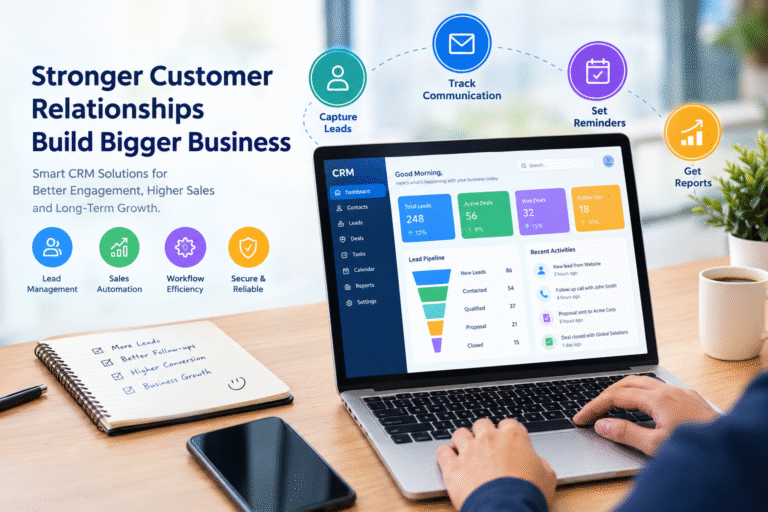
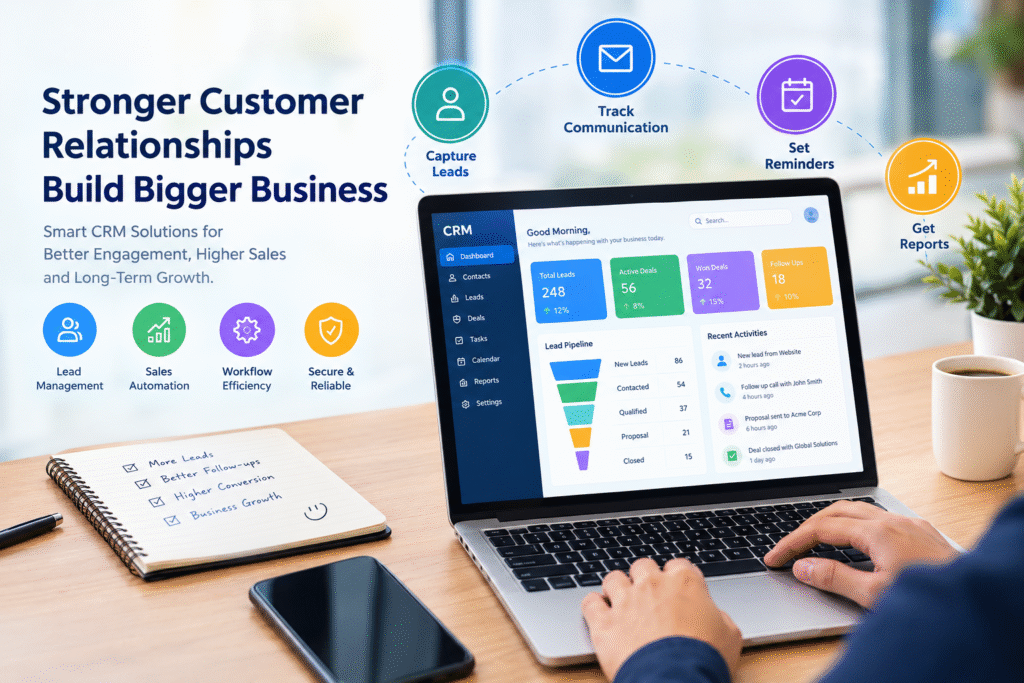
CRM stands for Customer Relationship Management. CRM software helps businesses manage customer information, sales activities, communication, and follow-ups through a centralized system.
CRM software development involves creating a system that fits a company’s working process.
Consider a software company that receives inquiries from its website every day. One person asks about pricing, another requests a product demonstration, and a third wants to discuss a custom project.
A CRM system makes the process easier. It records each inquiry, assigns the lead to a salesperson, stores conversation notes, and helps the team plan the next action.
The manager can also see how many inquiries the company received, how many prospects showed interest, and how many deals the team completed.
This is how CRM software helps a business turn customer information into an organized working process.
Why Do Businesses Need CRM Software?
Many businesses start by using Excel sheets, emails, and messaging applications. These tools may work at the beginning, but managing everything becomes difficult as the customer base increases.
CRM software helps solve several common business problems.
1. Keep Customer Information Organized
Customer details often remain scattered across different files and applications. Employees may waste time searching for phone numbers, previous discussions, or quotations.
A CRM keeps these details in one place. Authorized team members can review customer records and understand previous interactions before making a call.
2. Manage Leads and Follow-Ups
A lead is a person or business that shows interest in your product or service.
A CRM helps employees track each lead from the first inquiry to the final decision. They can schedule reminders, update lead status, and identify customers who need another conversation.
For example, a salesperson can set a reminder to call a prospect after sending a quotation. This reduces the chance of forgetting an important follow-up.
3. Reduce Repetitive Work
Employees often spend time assigning leads, updating spreadsheets, and sending internal reminders.
CRM automation can handle many of these tasks according to predefined rules. The system can create a lead from a website form, notify the assigned employee, and schedule a follow-up activity.
This allows employees to focus more on customer communication and sales activities.
4. Improve Team Coordination
Sales, marketing, and customer support teams often need access to the same customer history.
A shared CRM helps authorized employees review updates, record discussions, and understand the current status of a request. This reduces duplicate work and improves coordination.
5. Understand Sales Performance
Business owners need clear information to make good decisions.
CRM dashboards can show new leads, pending calls, active opportunities, completed deals, and sales trends. Managers can use these reports to identify delays and improve their team’s process.
CRM Software Development Services by Billion Info Tech
Every business has different requirements. A real estate agency may need property inquiry management, while a fintech company may require client onboarding and financial workflow tracking.
Billion Info Tech can help businesses explore CRM development services based on their operational needs, technical requirements, and long-term plans.
Custom CRM Software Development
Ready-made CRM platforms offer standard features, but some businesses need a system that follows their own processes.
Custom CRM software development allows companies to define the features they need. These may include customer profiles, lead assignment, sales pipelines, employee permissions, automated reminders, custom dashboards, and business reports.
For example, a software development company may need every new inquiry to pass through lead qualification, requirement discussion, quotation approval, and deal confirmation.
A custom CRM can organize these stages and help employees understand what they need to do next.
Sales CRM Development
Sales CRM software helps teams manage prospects throughout the sales journey.
Employees can record customer details, schedule calls, track proposals, update opportunity stages, and review previous discussions.
Managers can identify which leads need attention and understand how opportunities move through the sales pipeline.
CRM Automation Services
CRM automation reduces manual work by allowing the system to perform predefined actions.
A business can configure automatic lead assignments, follow-up reminders, internal notifications, and status updates.
For example, when a prospect submits an inquiry, the CRM can create a record and notify the relevant salesperson. If the lead remains active, the system can remind the employee to make another call.
CRM Integration Services
Many businesses already use separate applications for email, marketing, payments, accounting, and customer communication.
CRM integration connects compatible applications through APIs and other supported methods.
For example, a website contact form can send inquiry details directly to the CRM. This reduces manual data entry and helps the sales team respond quickly.
The available integration options depend on the external application’s technical capabilities, API access, and project requirements.
Cloud-Based CRM Development
Cloud-based CRM software allows authorized employees to access the system through supported devices and internet connections.
This approach can help teams working from different offices manage customer records and sales activities.
Businesses should also consider hosting expenses, data protection, access permissions, backups, and service availability before selecting a cloud-based solution.
CRM Development for Forex Brokers and Fintech Businesses
Financial service providers often manage complex customer journeys. Forex brokers and fintech companies may need to handle registrations, KYC verification, trading accounts, transaction requests, introducing broker relationships, and commission reports.
A specialized CRM can help organize these activities.
If the broker uses MT4 or MT5, a suitable integration may synchronize supported account details and trading information.
The business may also require deposit and withdrawal request management, IB commission calculations, client portals, and administrative reports.
A typical workflow looks like this:
Client Registration → KYC Review → Trading Account Setup → MT4/MT5 Integration → Transaction Tracking → IB Commission Reporting
Each stage requires clear rules and proper testing. For example, an IB commission may depend on trading volume, lot size, revenue share, or another agreed calculation method.
Billion Info Tech works across fintech software development services, making specialized CRM requirements an important area for businesses to discuss during project planning.
Essential Features of a Modern CRM System
A useful CRM should solve actual business problems. The feature list should reflect how employees manage customers every day.
Important features may include:
- Lead management: Capture and track new inquiries.
- Contact management: Store customer details and communication history.
- Follow-up reminders: Help employees remember calls and meetings.
- Sales pipeline: Track opportunities through different sales stages.
- Task management: Assign activities and monitor progress.
- Workflow automation: Reduce repetitive administrative work.
- Reports and dashboards: Review sales activity and business performance.
- User permissions: Control access to customer information.
- API integration: Connect the CRM to compatible applications.
- Security controls: Protect data through suitable authentication, permissions, and other safeguards.
- Mobile accessibility: Help authorized users manage work away from their desks.
Businesses do not need every feature from the beginning. Starting with the most important requirements can help control costs and make the system easier to use.
How Does the CRM Software Development Process Work?
A clear development process helps clients understand what the team will build and how the project will progress.
Step 1: Requirement Analysis
The team discusses the company’s existing workflow, customer journey, user roles, reporting needs, and technical requirements.
Step 2: Planning and Design
The team prepares the system structure, screen layouts, navigation, and user experience. The client reviews the proposed design before development moves forward.
Step 3: Software Development
Developers build the required frontend screens, backend logic, database structure, automation, and integrations.
Step 4: Testing and Quality Checks
The team tests lead creation, user permissions, notifications, reports, integrations, and data accuracy. Testing helps identify problems before launch.
Step 5: Deployment and Training
After approval, the team prepares the production environment and supports deployment. Employee training helps users understand the CRM and follow the correct workflow.
Step 6: Maintenance and Improvements
After launch, the business may need bug fixes, security updates, performance improvements, and additional features.
Clear communication between the client, project coordinator, developers, and testing team helps keep the work organized throughout the project.
Why Choose Billion Info Tech for CRM Software Development?
Selecting a CRM development company involves more than comparing prices. Businesses need a development partner that understands their requirements and explains the proposed solution clearly.
Billion Info Tech can help businesses explore CRM solutions based on their customer management processes, industry needs, and integration requirements.
Here are some important factors to consider when planning a CRM project.
A business-focused approach: Identify the problems your team faces and prioritize features that solve them.
Custom functionality: Plan the CRM around your workflow, user roles, and reporting requirements.
Integration planning: Identify the existing applications that need to exchange information and confirm their technical requirements.
Clear project coordination: Document the scope, timeline, responsibilities, testing stages, and expected deliverables.
Security and quality assurance: Include appropriate access controls, data protection measures, and testing activities.
Future scalability: Consider how the platform may need to expand as the business grows.
Before starting a project, discuss the expected features, estimated budget, ownership arrangements, support terms, and delivery milestones.
How Much Does CRM Software Development Cost?
CRM software development costs depend on the project’s size, features, and technical complexity.
A basic CRM may include contact management, lead tracking, reminders, and simple reports. A more advanced platform may require custom dashboards, workflow automation, mobile applications, multiple user roles, and specialized integrations.
The main cost factors include:
- Required features and development effort.
- Interface design and user experience.
- API integrations and third-party service fees.
- Data migration from existing systems.
- Security, testing, and compliance requirements.
- Hosting, maintenance, and technical support.
The best approach is to prepare a list of essential features before requesting a quotation. This helps the development team understand the project and estimate the required work more accurately.
Conclusion about CRM Software Development Company
Managing customer relationships should not require employees to search through multiple spreadsheets, remember every call, and update the same information repeatedly.
CRM software gives businesses a more organized way to manage leads, customer records, follow-ups, and sales activities. Custom development can also support specialized workflows and connect the applications a business already uses.
If you plan to develop a new CRM, upgrade an existing system, or connect different business applications, begin by identifying the tasks that need improvement.
Looking for a CRM Software Development Company? Contact Billion Info Tech to discuss your project requirements and explore a suitable CRM solution.
Frequently Asked Questions (FAQs)